Cytogenetic Analysis
What does Fragile X Syndrome look like under the microscope?
People started studying Fragile X Syndrome because it was observed that intellectual disabilities had a higher incidence in males, and multiple families started to report male members who were intellectually disabled (Harvey, Judge, & Weiner, 1977). Additionally, with the increasing use of cytogenetics to study chromosomal abnormalities that can cause disease, scientists sought to uncover the causes behind the high prevalence and inheritance of intellectual disabilities (Lubs et al., 1969).
Fragile X Syndrome was first written about in the scientific literature by name in 1981 by Mareni and Migeon (Mareni & Migeon, 1981). However, the cytogenetics of the disease were first observed by Lubs et al. in 1969. They discovered an abnormal X chromosome in people referred to chromosome studies because of their intellectual disabilities and other minor anomalies (Lubs et al., 1969). Lubs et al. found that in about a third of the affected males’ metaphases of leukocytes studied, there was an abnormal secondary constriction site on the end of the long arm of a group C chromosome, which was later identified as Xq27.3 (https://omim.org/entry/300624). The size and arm ratio of the chromosome along with the fact that only males were affected by this abnormal chromosome, led Lubs et al. to believe that the culprit was the X chromosome. It was this fragile site on the X chromosome seen under the microscope as a secondary constriction site that gave the disease its name – Fragile X Syndrome. Through family studies, they hypothesized that the intellectual disability phenotype was caused by the constriction site itself or a closely linked recessive gene through an X-linked recessive manner (Lubs et al., 1969). However, it has now been determined that the disease is actually inherited in an X-linked dominant mode of inheritance (https://omim.org/entry/300624).
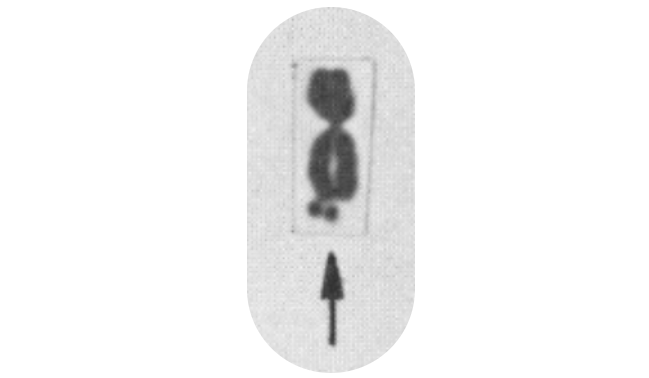
Researchers continued to study this fragile site without knowing the gene within the constriction site or its biochemical mechanisms. In a landmark paper in 1979, Sutherland found that composition of the tissue medium affects expression of the fragile site. Folic acid, folinic acid, and thymidine were found to inhibit expression of the fragile site (Sutherland, 1979). Additionally, pH was found to affect the expression of the fragile site with an increase in pH causing more frequent lesions at the fragile site (Sutherland, 1979).
Twelve years later, in 1991, two landmark papers published within a week of each other identified the gene within the fragile site that causes Fragile X Syndrome, FMR1, which codes for the horribly named protein, fragile X mental retardation protein (FMRP). The two papers identifying the gene were “Instability of a 550-Base Pair DNA Segment and Abnormal Methylation in Fragile X Syndrome” by Oberlé et al. and “Identification of a Gene (FMR-1) Containing a CGG Repeat Coincident with a Breakpoint Cluster Region Exhibiting Length Variation in Fragile X Syndrome” by Verkerk et al. Both papers reported a variation in length of the FMR1 gene from CGG repeats in the 5’ untranslated region of the gene as well as hypermethylation of the gene in affected males (Oberlé et al., 1991; Verkerk et al., 1991). Oberlé et al. found that individuals can be classified based on the number of CGG repeats they have in the 5’ untranslated region of the FMR1 gene. Individuals with less than 50 CGG repeats are “normal;” 50-200 CGG repeats deems someone as a carrier with the pre-mutation, and more than 200 CGG repeats causes someone to have Fragile X Syndrome (Oberlé et al., 1991). However, the range of 150-300 CGG repeats blurs the line between premutation and full mutation (Hagerman et al., 1994).
A few years later, Hagerman et al. found that differences in methylation of the CpG island next to the CGG repeats that occur during early embryogenesis can influence the level of the intellectual disability in affected males with the full mutation (Hagerman et al., 1994). It is believed that methylation silences the FMR1 gene, causing no FMRP to be encoded, so an intellectual disability is present because of the pathways that FMRP affects, which are discussed here (Hagerman et al., 1994). A spectrum of phenotypes can result from the different numbers of repeats, methylation patterns, and sex (Hagerman et al., 1994). Typically, full mutations are completely methylated, but there have been cases of Fragile X Syndrome where full mutations are incompletely methylated, and even more rare, there have been cases where the full mutation is completely unmethylated (Hagerman et al., 1994). Individuals with completely unmethylated full mutations are still able to produce some FMRP protein, albeit at lower levels than a person without Fragile X Syndrome. This causes a higher level of cognitive function in these individuals with a less severe intellectual disability phenotype. However, these individuals still had some behavioral and physical phenotypes associated with Fragile X Syndrome, so a higher number of CGG repeats without methylation is enough to produce a less severe case of Fragile X Syndrome (Hagerman et al., 1994). However, Hagerman et al. found that methylation may be more important in gene silencing than the CGG repeats, but methylation typically does not occur until there is expansion into a full mutation. The role that sex plays in determining disease manifestation is affected women have less severe phenotypes than men because of incomplete penetrance due to having two X chromosomes (Hagerman et al., 1994).
Research of the disease then shifted to elucidating the mechanism that caused the manifestation of Fragile X Syndrome from the variable CGG repeats and the methylation pattern of FMR1. It is hypothesized that the CGG repeats cause the constriction site by forming intrastrand tetraplexes through hydrogen bonding of guanines, which are stabilized through a potassium cation when the strand is being used as the template strand during DNA replication (Usdin & Woodford, 1995). These intrastrand tetraplexes can form a structural block to DNA synthesis and may cause the fragile site because the dense chromatin can’t be accessed to replicate, so it appears compact. The repeats could also cause strand slippage during DNA replication that results in the formation of more CGG repeats in offspring (Usdin & Woodford, 1995).
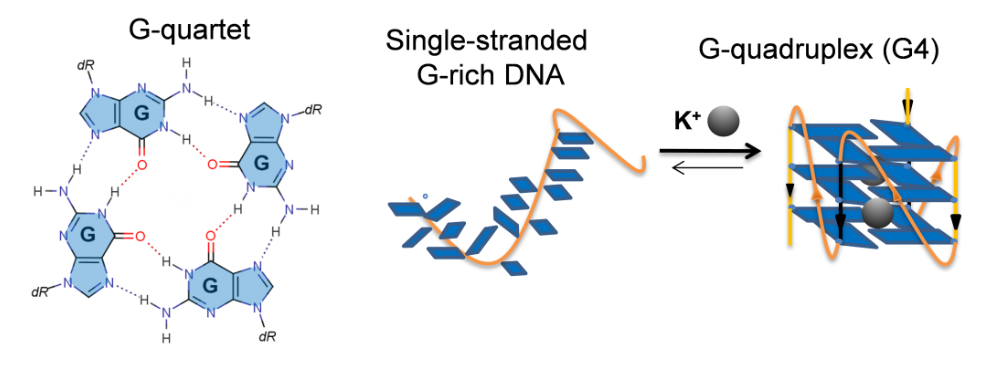
Another consequence of the hydrogen bonds between guanines forming the intrastrand tetraplexes is the prevention of transcription of the FMR1 gene, so no FMRP is produced. The effects of no FMRP in the cells can be read about here.
Works Cited
Hagerman, R. J.; Hull, C. E.; Safanda, J. F.; Carpenter, I.; Staley, L. W.; O’Connor, R. A.; Seydel, C.; Mazzocco, M. M. M.; Snow, K.; Thibodeau, S. N.; Kuhl, D.; Nelson, D. L.; Caskey, C. T.; Taylor, A. K. High Functioning Fragile X Males: Demonstration of an Unmethylated Fully Expanded FMR-1 Mutation Associated with Protein Expression. American Journal of Medical Genetics 1994, 51 (4), 298–308. https://doi.org/10.1002/ajmg.1320510404.
Harvey, J.; Judge, C.; Wiener, S. Familial X-Linked Mental Retardation with an X Chromosome Abnormality. J Med Genet 1977, 14 (1), 46–50.
Lubs, H. A. A Marker X Chromosome. Am J Hum Genet 1969, 21 (3), 231–244.
Mareni, C.; Migeon, B. R. Fragile X Syndrome: Search for Phenotypic Manifestations at Loci for Hypoxanthine Phosphoribosyltransferase and Glucose-6-Phosphate Dehydrogenase. Am J Hum Genet 1981, 33 (5), 752–761.
Oberlé I.; Rousseau F.; Heitz D.; Kretz C.; Devys D.; Hanauer A.; Boué J.; Bertheas M. F.; Mandel J. L. Instability of a 550-Base Pair DNA Segment and Abnormal Methylation in Fragile X Syndrome. Science 1991, 252 (5009), 1097–1102. https://doi.org/10.1126/science.252.5009.1097.
Sutherland, G. R. Heritable Fragile Sites on Human Chromosomes I. Factors Affecting Expression in Lymphocyte Culture. Am J Hum Genet1979, 31 (2), 125–135.
Usdin, K.; Woodford, K. J. CGG Repeats Associated with DNA Instability and Chromosome Fragility Form Structures That Block DNA Synthesis in Vitro. Nucleic Acids Res 1995, 23 (20), 4202–4209.
Verkerk, A. J. M. H.; Pieretti, M.; Sutcliffe, J. S.; Fu, Y.-H.; Kuhl, D. P. A.; Pizzuti, A.; Reiner, O.; Richards, S.; Victoria, M. F.; Zhang, F.; Eussen, B. E.; Ommen, G.-J. B. van; Blonden, L. A. J.; Riggins, G. J.; Chastain, J. L.; Kunst, C. B.; Galjaard, H.; Caskey, C. T.; Nelson, D. L.; Oostra, B. A.; Warren, S. T. Identification of a Gene (FMR-1) Containing a CGG Repeat Coincident with a Breakpoint Cluster Region Exhibiting Length Variation in Fragile X Syndrome. Cell1991, 65 (5), 905–914. https://doi.org/10.1016/0092-8674(91)90397-H.

Hi Paige. I really enjoyed your blog post! Have you found anything in the literature that hypothesizes why the FMR1 gene is differentially methylated across patients with Fragile X Syndrome? Does this only occur during embryonic development? Thanks!
Hello! I’m glad that you enjoyed it! To answer your question about when the methylation occurs, it is a debated topic about exactly when, but it definitely occurs before birth. I did not come across any papers that claimed people developed Fragile X Syndrome later in life. It is something that you are born with, thus occurs during embryonic development. This article reviews papers that argue methylation occurs as a post-zygotic event or is established in the female germ line and passed on to the fetus. Thus, the exact mechanism of methylation is still unknown from what I can find. Since the mechanism is not fully understood, I have not come across any hypotheses of why the FMR1 gene is differentially methylated. This was a great question concerning an area of research of Fragile X Syndrome that remains to be uncovered. I look forward to one day possibly reading about hypotheses and the mechanism of methylation of the FMR1 gene.