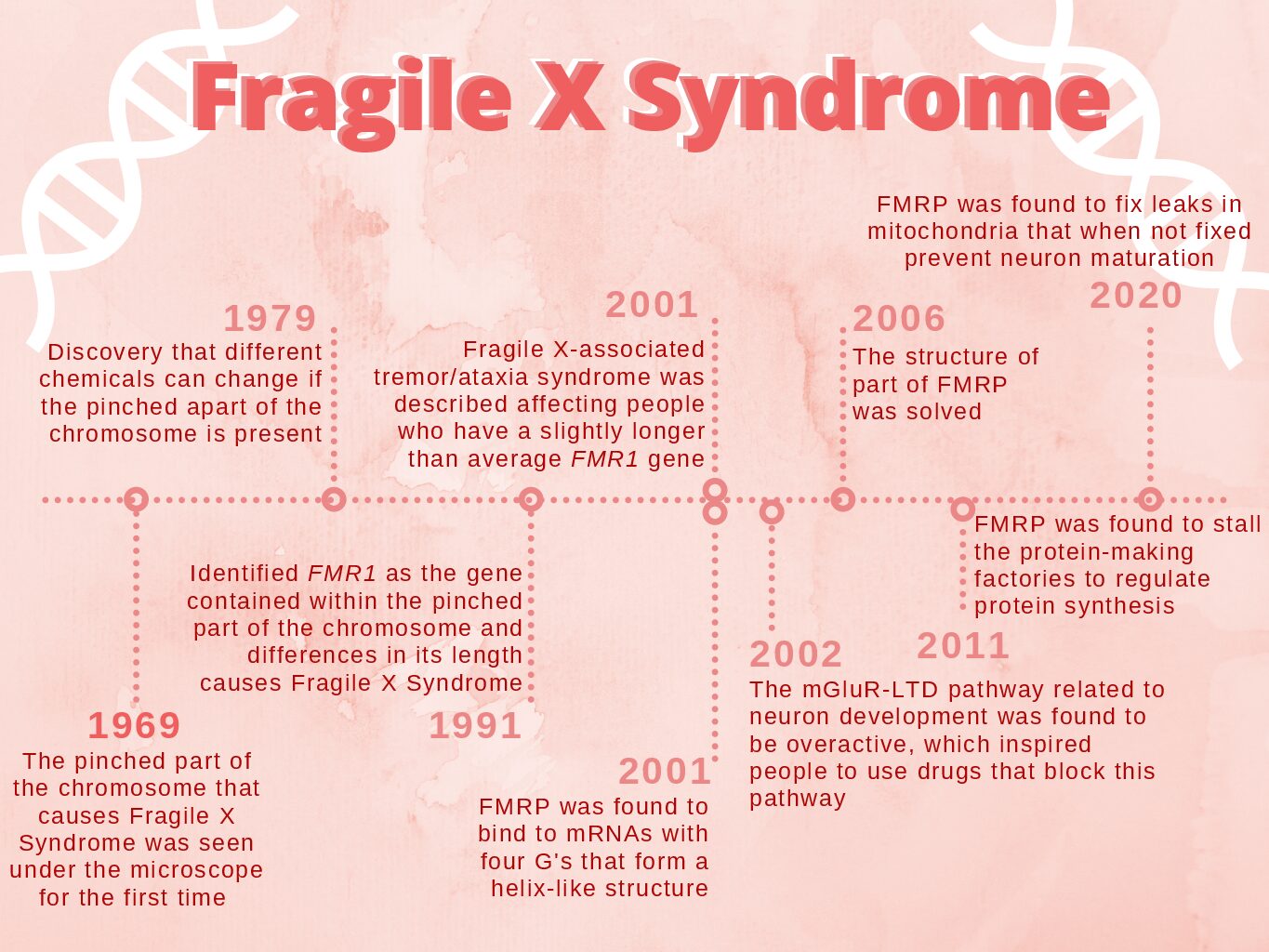
A Beginner’s Guide to Fragile X Syndrome
Fragile X Syndrome is an X-linked dominant genetic disease, which means it is caused by a change in DNA. DNA is essentially the instruction manual of our bodies to keep it making everything that it needs to function. There are four molecules called nucleotides that make up our DNA that we abbreviate as C, G, A, and T. When these four letters combine in different ways, they make “words” that provide the instructions on how to make proteins. Everyone’s letter combinations differ slightly, and that’s what makes us unique!
Just like any other book or manual, DNA has “chapters,” where each chapter, which scientists call a gene, holds the instructions to make a specific protein. The gene, FMR1, holds the instructions to make the terribly named fragile X mental retardation protein (FMRP). In the average person, at the beginning of the FMR1 chapter, there are less than 50 CGG repeats, meaning the molecules CGG show up consecutively in that order less than 50 times. 50-200 CGG repeats makes someone a carrier. Individuals with over 200 CGG repeats have Fragile X Syndrome.
How do these extra words or nucleotide repeats at the beginning of the “chapter” or gene cause Fragile X Syndrome? It has to do with chromosomes, which can be thought of as books within a series, if our DNA is the entire series. Each chromosome (book) contains a certain number of genes (chapters).
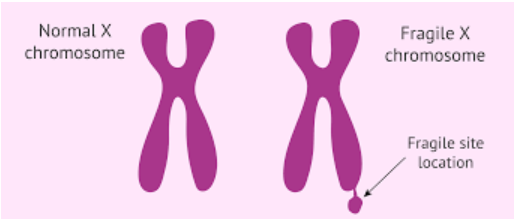
In the Fragile X chromosome, we can see a bubble. Where the bubble is attached to the chromosome is called the fragile site, which is where the disease gets its name! To see what the fragile site looks like on a real chromosome, click here! In order for proteins to be made, something needs to be able to copy the instructions from the DNA and turn it into mRNA. But when the DNA is constricted at the fragile site, the reader can’t get in to copy the instructions and make proteins. This causes cells to not have any FMRP. Click here to dive deeper into how the disease manifests at the DNA level.
FMRP is typically found in all cells, but primarily in neurons. It regulates when certain proteins are made to make sure that the cell is not wasting energy by making proteins it doesn’t need by blocking ribosomes. FMRP likes to bind to mRNAs that have a lot of G’s in their instructions and code for proteins involved in synapse formation. One pathway in the cell that FMRP works to regulate is the PI3K signaling pathway, which keeps neurons proliferating during development and not differentiating into unique neurons with individual duties to carry out in the body. Other pathways involved in neuron development such as mTOR and ERK1/2 signaling are also overactivated when FMRP is not present to regulate them. This causes immature neurons that cannot effectively pass signals in the body, which causes the main phenotype of Fragile X Syndrome – an intellectual disability. Other physical phenotypes include a long, narrow face, slightly enlarged head and testes, a prominent jaw, and protruding ears. Behavioral phenotypes include hyperactivity, anxiety, repetitive behaviors, and autism.
Another pathway affected by the absence of Fragile X Syndrome is the electron transport chain, which is the pathway in the mitochondria that creates our energy source and gives mitochondria its famous tagline – The powerhouse of the cell!

FMRP controls the production of a protein involved in the electron transport chain, called Coenzyme Q, so when FMRP is absent, Coenzyme Q is absent. This makes the electron transport chain less efficient, so the mitochondria have to work harder to keep up their reputation of being the powerhouse of the cell. The inefficient mitochondria keep neurons in an immature state, just like in the signaling pathways above.
Fragile X Syndrome can’t be cured…yet! But treatments have been tested to try and relieve some of the phenotypes associated with Fragile X Syndrome. When mice with no FMRP were supplied with Coenzyme Q, their electron transport chain started functioning normally again and hyperactivity and repetitive behaviors associated with Fragile X Syndrome were reduced! Many other papers have studied the use of inhibitors to try and get the overactivated pathways discussed above back under control. One such inhibitor is cercosporamide.

Research about Fragile X Syndrome continues to provide information on how it is caused, how other parts of the body are affected, and how we can fix it! There is a lot more to learn, but we can start here to build a foundation to understand new research to come!
To learn more about this disease, click through the pages below!

How many chromosomes does a person typically have?
Hi, Allan! Thank you for your question. A person typically has 2 sets of 23 chromosomes – a set from each parent – for a total of 46 chromosomes. Fragile X Syndrome occurs on the X chromosome, which is one of the 23rd chromosomes, which are the sex-determining chromosomes. If a person inherits an X chromosome from both their mom and dad, they are assigned as a female at birth. When a person inherits an X chromosome from their mom and a Y chromosome from their dad, they are assigned as a male at birth. This is why Fragile X Syndrome is more common in males because they only have one X chromosome, so if their one X chromosome is affected, they will express the disease. The odds of females inheriting two affected X chromosomes are small, and if only one is affected, it can be inactivated since they have two copies of the X chromosome.
Loved the analogy you used with book chapters and DNA!!!!!! Do you feel as though the protein could be renamed to exclude the terrible word ?
Hi, Abbey! Thank you for your compliment and insightful question! Since there are 30 years worth of research that have been published using the current name of the protein, I fear that changing it would lead to lost information on the disease in the future because the literature that uses the old name would get lost in searches. I think the best solution moving forward would be for papers to only call the protein “FMRP” and not clarify what the acronym is short for. Unfortunately, it would still carry on the memory of the bad word, but at least it wouldn’t be explicitly stated and used.
Very intriguing!
Thanks, Dad!